
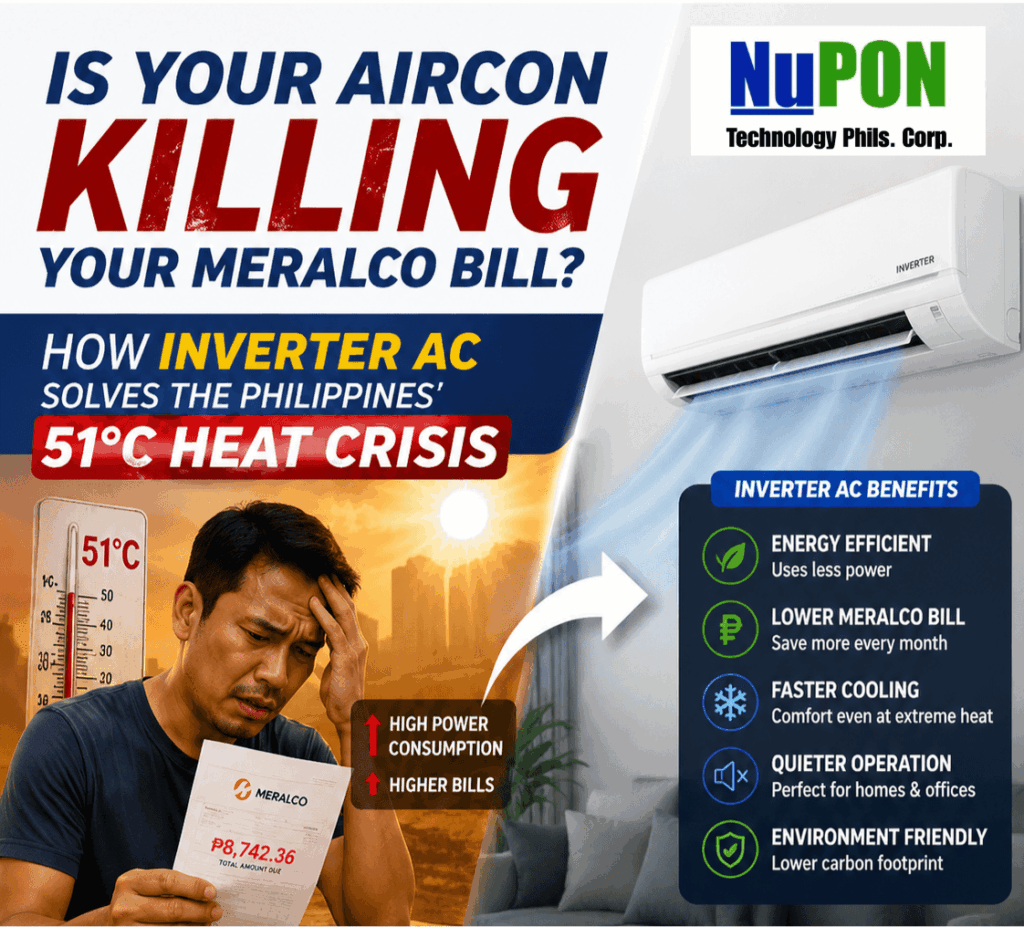
With PAGASA issuing dangerous heat alerts and electricity costs among the highest in Southeast Asia, Filipino homeowners are at a crossroads. Here’s the evidence-backed answer every household needs right now.
A Country Caught Between Dangerous Heat and Soaring Electricity Bills
The Philippines sits uncomfortably at the intersection of two crises in 2026: a worsening heat emergency that has placed the country among the three most heat-impacted nations in Asia, and an ongoing energy emergency that has sent electricity prices into territory that strains ordinary household budgets. For millions of Filipinos, these two forces are pulling in opposite directions — the body demands cooling, but the wallet screams otherwise.
PAGASA’s records show a heat index of 51°C in 2019, a figure that experts now warn could be exceeded as climate patterns intensify. As of this writing in May 2026, extreme heat advisories are in effect across much of Luzon, Visayas, and Mindanao, with “dangerous” classifications prompting warnings of heat stroke even for individuals at rest indoors.
“Staying cool isn’t just about comfort in the Philippines — it’s a public health necessity, especially for children, the elderly, and outdoor workers.”
At the same time, the 2026 Philippine energy emergency — triggered by disruptions to the global oil supply — has compounded existing electricity price pressures. Philippine electricity rates were already among the highest in Southeast Asia even before the current crisis. For families already stretched by inflation, a Meralco bill that climbs past ₱8,000–₱10,000 per month in summer is a genuine household emergency.
⚠ Heat Index Warning
A heat index above 41°C is classified as “dangerous” by PAGASA — heat cramps, exhaustion, and heat stroke are likely without cooling measures. This level is being recorded in multiple Philippine cities during peak afternoon hours in 2026.
The Reality:
Why Aircon Is No Longer a Luxury — It’s Infrastructure
For decades, air conditioning was a marker of prosperity in the Philippines. Today, it is increasingly a necessity tied to health, productivity, and even livability. The numbers tell the story clearly: the Philippine AC market was valued at ₱590 million in 2025 and is projected to reach nearly ₱940 million by 2034, growing at over 5% annually.
AC penetration — currently estimated at between 5% and 15% of households — is projected to surge by up to 600% by 2030, according to the ASEAN Centre for Energy. This isn’t lifestyle inflation. It’s the arithmetic of survival in a tropical country where average temperatures from April to July have climbed from 26°C to over 33°C in just four years.
Work-from-home arrangements, which became widespread after 2020, have only deepened the need. Filipino professionals who once relied on office cooling systems now run household units for 8–12 hours daily. The result: electricity bills that shock even careful budgeters, and a growing urgency to find a smarter solution.
The Solution:
Inverter vs. Non-Inverter Aircon: What the Data Actually Shows
The core insight driving the Philippine aircon market in 2026 is this: inverter technology has become the clear default choice for Filipino buyers who run their AC for extended hours. It is no longer a premium luxury — it is the rational economic choice for most households.
Here is how the two technologies compare in real-world Philippine conditions:
| Feature | Inverter Aircon | Non-Inverter Aircon |
|---|---|---|
| How it works | Adjusts compressor speed to maintain temperature — runs continuously at variable power | Turns compressor fully ON or OFF — cycles repeatedly at maximum power |
| Energy efficiency | Up to 60% more efficient | Higher energy spikes per cycle |
| Best for… | Daily use of 6+ hours; work-from-home; overnight cooling | Occasional, short-term use only (under 4 hours) |
| Noise level | Quieter — compressor modulates speed | Louder — compressor starts at full power each cycle |
| Lifespan | Longer — less mechanical stress from cycling | Shorter — constant ON/OFF cycling causes wear |
| Monthly Meralco impact (8hrs/day) | ~₱1,200–₱1,600 | ~₱2,000–₱3,200+ |
| Upfront cost | Higher initial purchase price | Lower initial purchase price |
| Long-term verdict | Saves thousands per year | Costs more over 2–3 years |
The Right Size Matters as Much as the Technology
Choosing inverter technology is only half the equation. An incorrectly sized unit wastes energy regardless of how advanced its compressor is. Filipino homes typically need 20–25 BTU per square foot, though ceiling height, direct sun exposure, and the number of occupants all affect this. Undersized units work too hard and never reach target temperatures; oversized units cool too quickly without removing humidity, leaving rooms cold but sticky — a common Philippine summer complaint.
✓ Quick Sizing Guide
Small bedroom (12–16 sqm): 0.75–1.0 HP · Standard bedroom (16–22 sqm): 1.0–1.5 HP · Living room or sala (22–35 sqm): 1.5–2.0 HP · Large open-plan area (35 sqm+): 2.0–2.5 HP. When in doubt, consult a licensed technician — the right sizing decision pays for itself within months.
For Philippine conditions specifically, look for units running on R32 refrigerant, which is more eco-friendly and increasingly the standard among quality brands available in Manila and major cities. Smart features — including mobile-app controls, geofencing that starts cooling as you approach home, and energy consumption monitoring — are no longer exclusive to premium tier.
Follow our facebook page to learn more: https://www.facebook.com/NuponACServices