
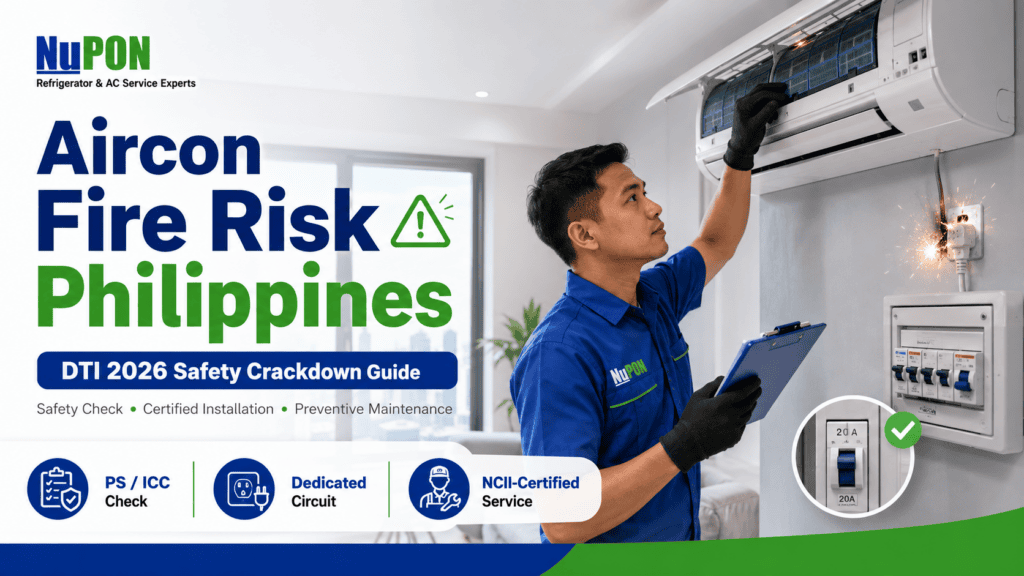
It rarely announces itself. A breaker that trips twice in one week. A faint warm smell near an outlet nobody investigates. An installer who mounted the unit fast and cheaply, and never mentioned a dedicated circuit. Multiply that pattern across millions of Philippine households running aircons non-stop, and you get exactly the trend the Department of Trade and Industry (DTI) flagged in 2026: over 7,400 fires in 2025 traced to electrical causes — more than any other cause of fire in the country, including cooking and open flame. Air conditioners sit right in the middle of that story, and the fix is more specific than “buy a good brand.”
7,400+ electrical fires were recorded nationwide in 2025. 113 product categories DTI now regulates for safety marks. 1 dedicated circuit breaker standing between a normal Tuesday and a call to the fire department.
The Story Behind the Warning: Why DTI Is Watching Aircon Sellers Right Now
This isn’t an old advisory recycled for clicks. The Bureau of Fire Protection’s own numbers show electrical issues as the single leading cause of residential fires in the Philippines, ahead of unattended cooking and open flame combined in several regions. In 2025, that meant more than 7,400 fire incidents nationwide traced back to wiring, arcing, and overloaded circuits. Early 2026 data shows no slowdown — hundreds of electrical fires were already logged by the end of January alone.
So what is DTI actually doing about it? The Bureau of Philippine Standards (DTI-BPS) is urging buyers to check for a genuine Philippine Standard (PS) mark or Import Commodity Clearance (ICC) sticker before buying any regulated appliance — including air conditioners. As of March 2026, around 1,700 manufacturers held active PS licenses covering 113 regulated categories under DTI Department Administrative Orders No. 18-03 (2018) and No. 22-01 (2022). And this enforcement has teeth: in late June 2026, a national news report covered DTI inspectors removing appliances lacking proper safety markings from a department store shelf in Pasig City — part of a sweep that now includes online marketplaces, not just physical retailers.
Translation for anyone shopping for a new split-type or window unit this year: the seller’s paperwork now matters as much as the price tag on the box.
Why Air Conditioners Are the Riskiest Appliance in a Filipino Home
A rice cooker runs for 20 minutes. A flat iron, maybe 10. An air conditioner compressor can run for 8, 10, sometimes 16 hours straight through a hot, humid stretch — which is exactly why fire-prevention advisories keep circling back to it.
- Constant, punishing load. Nothing else in a typical household pulls current this continuously, which means wiring sized for occasional use gets pushed well past what it was built for.
- Heat eats capacitors alive. The starting capacitor — the part that gives the compressor and fan motor their initial kick — degrades fastest in exactly the conditions the Philippines specializes in: high ambient heat, poor outdoor-unit airflow, near-24/7 runtime.
- Brownouts make it worse. Every voltage dip and surge stresses capacitors and circuit boards a little more — a failure pattern technicians report as a recurring, not rare, event.
- The “octopus connection” trap. Plugging a high-draw aircon into a shared general-purpose outlet instead of a dedicated line is one of the most common patterns fire safety advisories name as a leading residential fire hazard — and one of the easiest to fix before it becomes a headline.
How NuPon closes this gap: As an authorized Carrier dealer, NuPon sources genuinely certified, correctly rated units from the start — so this root cause never makes it past the sales conversation.
The 3 Root Causes — and How NuPon Closes Each One
1. Uncertified or Counterfeit Units and Parts
Not every unit sold in the Philippines carries a genuine PS mark or ICC sticker, and a substandard compressor or capacitor doesn’t announce itself at checkout — it sits behind your wall quietly overheating for years. The uncertified extension cord powering the unit is often just as dangerous as the unit itself; a cheap, unmarked cord carrying an air conditioner’s full load is a textbook cause of melted insulation and arcing.
How NuPon closes this gap: As an authorized Carrier dealer, NuPon sources genuinely certified, correctly rated units from the start — so this root cause never makes it past the sales conversation.
2. Improper or Unlicensed Installation
An aircon installed without its own dedicated circuit breaker — sharing a line with the fridge or kitchen appliances instead — is set up to overload from day one. So is one wired with an undersized cable, loose crimped connections, or a breaker rated wrong for the load. These are precisely the details a non-certified “installer for hire” is most likely to skip, because sizing a circuit to code isn’t guesswork — it’s training.
How NuPon closes this gap: Every NuPon installation is handled by a TESDA NCII-certified technician following a documented job-hazard checklist — the same electrical-isolation and circuit-sizing standard NTPC applies across its own industrial HVAC installation projects, adapted for the home.
3. Deferred Preventive Maintenance
Dust buildup, a slowly failing capacitor, or a loosening electrical connection rarely announces itself — until the breaker starts tripping, a burning smell appears, or the unit simply stops starting. Skipping the recommended 3–6 month check lets small issues quietly progress into the overheating components and arcing contacts that actually start fires.
How NuPon closes this gap: Scheduled preventive maintenance visits check the capacitor’s condition, wiring integrity, and drainage — catching the failure before it becomes a smell, a spark, or a bigger bill.
The 7-Point Safety Audit: Check Your Own Aircon Today
This takes less time than waiting for your air conditioner to cool a room. Go unit by unit:
- Does the unit or its extension cord show a PS mark or ICC sticker? Check the original box, manual, or receipt if it’s an older unit.
- Is it plugged into a dedicated outlet with its own breaker — not shared with the fridge, TV, or kitchen appliances?
- Has the breaker tripped more than once when the unit starts up? That’s a warning, not a coincidence.
- Any burning smell, discoloration, or unusual warmth around the outlet or breaker panel?
- Has it been more than 6 months since a professional cleaning and inspection?
- Any adapters, extension cords, or “octopus connections” standing in for a proper wall outlet?
- Was it installed by an NCII-certified technician — or by someone without formal HVAC electrical training?
Two or more “no,” “not sure,” or “it’s been a while” answers mean it’s worth a professional look before the next heavy-use stretch, not after the breaker gives up.
NuPon: Built by the Same Standards NTPC Uses for Industrial Safety
NuPon Refrigerator & Aircon Service Experts serves residential, condominium, and commercial clients across Laguna, Cavite, Batangas, and Manila — installing, inspecting, and maintaining aircon systems with technicians who carry TESDA NCII certification, not on-the-job guesswork. That standard isn’t borrowed for marketing; it comes from the same safety culture behind NTPC’s ISO 9001:2015 and ISO 14001:2015 certifications and its documented Job Hazard Analysis procedures for HVAC installation work.
In practice, that means every NuPon visit — install, repair, or maintenance — follows the same principle: find the failure point before it finds you. Genuinely certified units from an authorized Carrier dealer. Dedicated circuits sized to code. Capacitors and wiring are checked on a schedule instead of after something already smells wrong.
Frequently Asked Questions About Aircon Fire Safety in the Philippines
What causes most aircon-related electrical fires in the Philippines?
Most cases trace back to overloaded or shared circuits, aging or substandard capacitors that overheat, and connections loosened over time by voltage fluctuations. Uncertified units and improper installation — especially skipping a dedicated circuit breaker — compound these risks significantly, according to fire safety data from the Bureau of Fire Protection.
How do I know if my aircon has a genuine PS mark or ICC sticker?
Check the unit’s casing, original packaging, or manual for a holographic PS mark (local manufacture) or ICC sticker (imported units), issued per DTI-BPS regulations. If you can’t locate either or bought from an unverified online seller, ask your installer or the retailer to confirm certification before installation.
Does my residential air conditioner need its own dedicated circuit breaker?
Yes. Split-type and higher-HP window units should run on a dedicated circuit with its own breaker, separate from other household appliances. Sharing an outlet or circuit with other high-draw devices is a leading cause of overloading, tripped breakers, and, over time, overheated wiring.
How often should I get preventive maintenance to reduce fire risk?
Every 3 to 6 months, depending on usage and environment, is the standard recommendation for Philippine conditions. Units running nearly continuously during hot months or in dusty environments may need more frequent checks, since capacitor and wiring issues tend to progress quietly between visits.
Can DIY aircon cleaning or installation cause a fire hazard?
It can. DIY work often misses circuit sizing, proper crimping, and correct breaker ratings — the exact details an NCII-certified technician is trained to check. Household cleaning attempts can also leave moisture near electrical components if not done carefully, which adds its own risk on top of the wiring issue.
Why choose an NCII-certified provider like NuPon over an independent installer?
NCII certification means a technician has been formally tested on circuit sizing, electrical safety, and installation standards — not just how to mount a unit. NuPon pairs that certification with authorized Carrier dealer status and NTPC’s ISO-certified safety procedures, closing the exact gaps most linked to air conditioning fire risk.
Book a Certified Safety Check Before the Breaker Decides For You
A tripped breaker or a burning smell is your aircon’s last warning, not its first. NuPon’s NCII-certified technicians serve homes across Laguna, Cavite, Batangas, and Manila with certified installation, preventive maintenance, and repair — built around genuine electrical safety, not just cold air.
Call or Viber: +63 998 599 9891 | Email: nuponcbd@gmail.com | Request a Free Quote
Last updated: July 2026 · A safety field guide from NuPon’s NCII-certified aircon technicians